The Law Firm That Still Runs Conflict Checks by Email
Most mid-size law firms are deploying AI in the wrong place — racing it into research and drafting where hallucinations become malpractice. The highest-ROI, lowest-risk deployment is intake. Here's what that actually looks like.
Your firm takes on a major multi-vehicle accident case. Associates spend weeks on it. You're deep into discovery. Then someone pulls the full conflict check — properly, this time — and finds that three years ago, your firm represented the spouse of an adverse driver in an unrelated divorce proceeding. The judge disqualifies you. The time is forfeited. The client is gone. The conflict was sitting in your system the whole time. Nobody ran the check right.
This isn't a hypothetical. It's the pattern behind why CNA Insurance, one of the largest legal malpractice insurers in the country, calls conflicts of interest "a leading cause of legal malpractice claims for years." About 20% of malpractice risk traces back to conflicts, according to the DRI Survey. And the reason it keeps happening is the same at firm after firm: intake is still running on email chains, manual lookups, and institutional memory.
The Wrong Place to Start With AI
I keep seeing the same thing in 2026. Managing partners at mid-size firms finally have budget and board pressure to do something with AI. Harvey and Clio Duo have legitimized the category. So the question becomes: where do we start?
And almost every firm answers the same way: legal research, document drafting, and memo generation.
That's the wrong answer.
Ann Srivastava, a legal tech practitioner who built a working AI intake agent in a single night, put it plainly: "Law firms are putting AI in the wrong place. Every major firm is racing AI into legal research, drafting, and memos. That's exactly where hallucinations become malpractice."
She's right. A fabricated case citation already sanctioned real lawyers — Mata v. Avianca in 2023, where attorneys submitted ChatGPT-generated citations that didn't exist. A hallucinated statute in client advice is worse. The malpractice surface in research and drafting is enormous. The malpractice surface in intake is essentially zero.
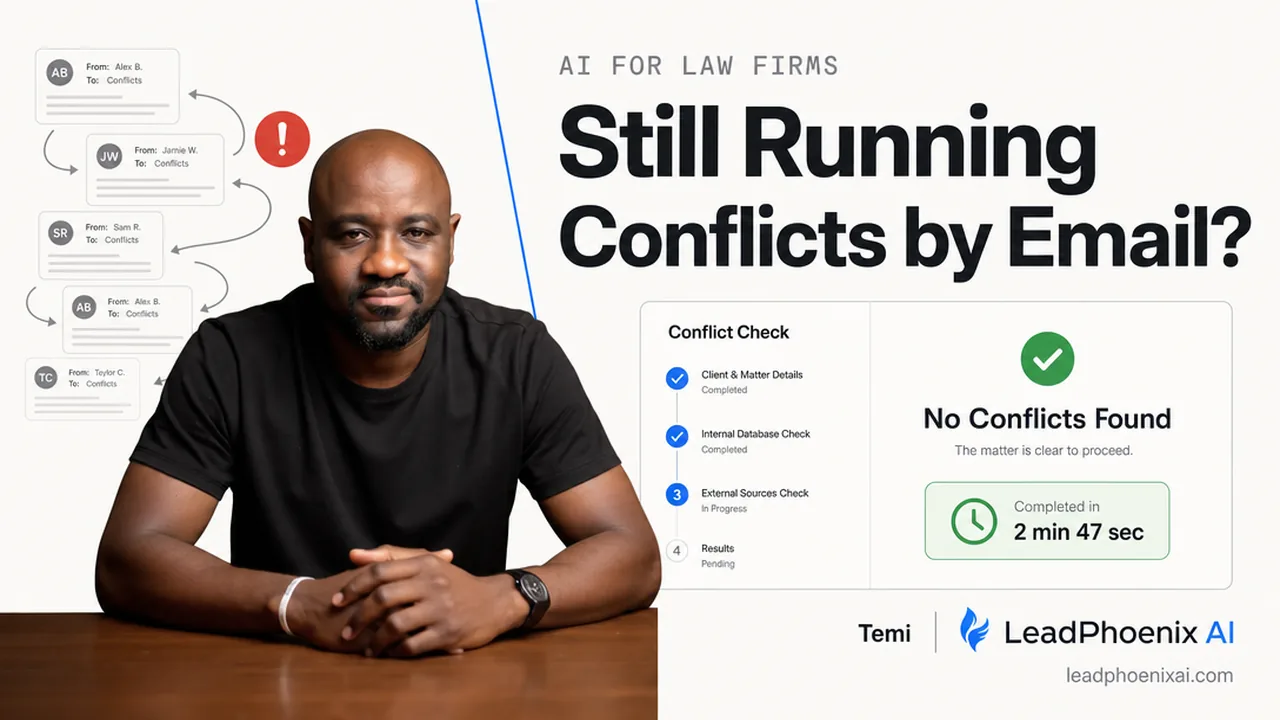
The agent isn't practicing law. It's qualifying leads, running conflict checks, routing matters, and preparing the file. No legal inference. No hallucination risk. Just a structured process that currently takes 45 to 90 minutes per matter running in under 3 minutes.
What's Actually Broken in Intake Right Now
Let me describe what intake looks like at most mid-size firms today.
A potential client calls or fills out a web form. Someone — usually a paralegal or junior associate — takes the initial information. They send an email to check conflicts. That email goes to whoever manages the conflicts database, which might be a spreadsheet, might be a field in the practice management system, might be both and neither is fully current. The response comes back in a few hours, or the next day. If there's a flag, it goes to a partner. The partner responds when they get to it. The engagement letter gets drafted manually. The matter gets opened in the system by hand.
The whole process takes two to five days. Sometimes longer.
And the miss rate on those manual conflict checks? Research suggests 25 to 30% of potential conflicts go undetected when the process is manual. That's not a rounding error. That's a structural exposure.
Actionstep estimates inefficient processes cost firms up to $70,000 annually per attorney in lost billable time. That figure comes from a vendor with commercial interest in it, so treat it as illustrative rather than gospel. But even if the real number is half that, you're looking at a meaningful P&L leak that doesn't show up as a named line item. It shows up as slow matter ramp, write-offs, and the occasional disqualification.
The Agentic Shape That Fixes It
Here's what an AI intake agent actually does when it's built right.
A new matter inquiry comes in, whether by web form, email, or phone call transcribed to text. The agent immediately pulls the prospective client's name, entity, and related parties and runs them against iManage, Aderant or Elite 3E, and the firm's CRM simultaneously. Not sequentially. Simultaneously. It's checking matter history, existing client relationships, open AR balances, and prior conflict flags in one query.
That cross-silo correlation is the thing most firms have never been able to do before. Not because the data didn't exist, but because it lived in three systems that had never been connected. The agent doesn't just check conflicts. It surfaces whether this prospective client has an outstanding balance from a prior engagement, whether a related party is adverse in a current matter, whether the referring attorney has a relationship that needs to be disclosed.
If everything clears, the agent routes the matter to the right practice group based on matter type, generates a draft engagement letter, and schedules the intake call, all before a human touches the file.
If there's a flag, it escalates to the intake coordinator with a summary of exactly what it found and where. The coordinator reviews and approves. Nothing goes to the partner until the agent has cleared the checklist or flagged the specific issue that needs human judgment.
The agent suggests. The human approves. That's the design.
Using Claude Code, Srivastava built a version of this for a fictional immigration firm in one night, with a 17-question intake, Calendly booking, and Gmail brief delivery. The point isn't that you should build it yourself in a night. The point is that the technical barrier is not what's stopping mid-market firms. The barrier is that nobody has connected the systems and scoped the workflow.
Why Mid-Market Firms Are the Gap
The enterprise legal AI market has a distribution problem.
Harvey raised $300 million and serves elite firms. CoCounsel runs $900 a month per seat. Bloomberg Law's June 2026 survey found that all 40 firms with 500 or more attorneys used legal-specific AI tools in 2025. That's the top of the market, and it's covered.
At the other end, Clio and Lawmatics are building CRM-layer automation for solos and small firms. Lawmatics launched QualifyAI and EngageAI in March 2026 — lead qualification and outreach agents that work well for high-volume consumer practices.
The 50-to-350-lawyer firm sits in the middle of both of those markets and is served by neither. Too large for the solo-focused tools. Too small and too cautious for the BigLaw platforms. Alex Shahrestani at Promise Legal described it well: "Even the bullish firms on AI are still hyper-cautious about it. The careful nature of the average lawyer is the key factor here."
That caution is rational when you're talking about research and drafting. It's irrational when you're talking about intake. The risk profile is completely different.
And the competitive window is real. There's no "Harvey for mid-market intake" yet. The firms that build this infrastructure in the next 18 months will have a process advantage that compounds before the category gets crowded: faster matter ramp, lower malpractice exposure, and better partner visibility into the pipeline.
The Source-of-Truth Problem Underneath All of This
I want to be direct about something, because I see firms try to shortcut this and it doesn't work.
You cannot build an effective intake agent without first connecting your systems into a single source of truth. iManage has a conflicts and intake module. Aderant has matter opening workflows. Your CRM has relationship data. But none of those talk to each other natively. The cross-silo query, the one that checks conflicts, AR exposure, and relationship history in one pass, only works if there's a unified data layer underneath it.
This is the part that isn't glamorous. It doesn't look like transformation from the outside. But it's the foundation everything else runs on. An intake agent built on top of disconnected systems will give you faster output from broken data. That's not an improvement.
The right sequence is: connect the systems first, then build the agent on top of the connected layer. The source-of-truth work is where the real transformation happens. The agent is just the interface.
Once that layer exists, the questions you can ask change entirely. "Show me every matter opened in the last 90 days where the conflict check took more than 24 hours." "Show me every client with open AR who has a new matter in intake right now." "Show me every referral source whose matters have the highest realization rate." None of those queries were possible before. All of them are table stakes once the data is connected.
What to Do This Week
If you're a managing partner or COO at a mid-size firm and this describes your intake process, the move isn't to buy another point solution. It's to answer three questions first.
Where does your conflict data actually live today — and is it current? Where does your client relationship history live, and can it be queried programmatically? And what does your matter opening process look like from first contact to engagement letter, step by step?
Those three answers tell you whether you have a data architecture problem, a workflow design problem, or both. Most firms have both. And until you know which, you're not ready to deploy an agent. You're ready to automate a broken process, which just makes the bad output arrive faster.
If you want a structured way to answer those questions, our AI Readiness Audit is a two-week engagement that maps your current systems, identifies the highest-ROI intake automation use cases for your specific stack, and gives you a 90-day implementation roadmap. It's the right starting point before you build anything.
Frequently Asked Questions
Does an AI intake agent create unauthorized practice of law concerns? No, when scoped correctly. The agent qualifies leads, runs conflict checks against your existing data, routes matters, and generates draft documents for attorney review. It doesn't provide legal advice, interpret law, or make legal judgments. The attorney reviews and approves every output before it goes to the client. That's the same standard as a paralegal-assisted intake process — the agent just runs it faster and more consistently.
What systems does an intake agent need to connect to? At minimum: your conflicts database (often iManage or a field in Aderant/Elite 3E), your matter management system, your CRM or relationship tracking tool, and your document generation system for engagement letters. The agent's value comes from querying all of those in one pass — which requires a unified data layer underneath it, not just point-to-point integrations.
How long does it take to deploy an intake agent at a mid-size firm? Once the source-of-truth layer is in place and the systems are connected, a scoped intake agent typically takes two to four weeks to configure and test. The longer timeline is usually the data architecture work that has to happen first — mapping what lives where, cleaning stale conflict records, and establishing API access to the relevant systems.
What's the ROI case for automating intake? There are two sides to it. The efficiency side: manual conflict checks take 45 to 90 minutes per matter; automated checks run in under 3 minutes. At any meaningful matter volume, that's significant associate and paralegal time redirected to billable work. The risk side is harder to quantify but more important: conflicts of interest account for approximately 20% of legal malpractice risk, and manual checks miss 25 to 30% of potential conflicts. One avoided disqualification or malpractice claim pays for years of the system.
Can a mid-size firm build this without a full-time AI hire? Yes. The firms that are moving on this are doing it through fractional AI leadership — someone who comes in, connects the systems, scopes the agent, and deploys it without requiring a $300K internal hire. The key is finding someone who has built on your specific stack (iManage, Aderant, Clio, NetDocs) before, because the integration work is where most implementations stall.
Sources
Cited inline above:
- Ann Srivastava (@helloparalegal) — AI Intake Concierge practitioner demo thread
Additional sources consulted for this piece:
- DRI — Law Firm Malpractice Risk Survey
- CNA Insurance — Legal Malpractice Risk Management resources
- Actionstep — Law Firm Efficiency and Billable Time research
- American Bar Association — 2025 Legal Technology Survey Report
- Bloomberg Law — Leading Law Firms AI Survey, June 2026
- Lawmatics — QualifyAI and EngageAI product announcements, March 2026
- iManage — Conflicts and Intake product documentation
- Harvey AI — Matter intelligence platform overview
- Best Law Firms / U.S. News — AI adoption in law firms feature, October 2025
- ABA Model Rules of Professional Conduct — Rule 1.10, Imputation of Conflicts of Interest